
 Available in US
Content

I check the outright winner odds for the next Rugby World Cup roughly once a month, starting two years before kick-off. Not because the prices move dramatically in any given month, but because the pattern of movement — which teams are drifting, which are shortening, and which are static — tells a story about how the market is reading form, injury, and sentiment. Rugby world cup winner odds are the single most liquid market in rugby betting, and understanding how they form, shift, and occasionally misprice is the entry point for any serious tournament strategy.
The global sports betting market generated $100.9 billion in 2024 and is projected to reach $258 billion by 2033. The RWC outright winner market is a fraction of that total, but it commands outsized attention because it runs for months before the tournament and attracts both recreational punters and sharp money. That blend of casual and analytical interest creates a price discovery process where mispricings are rare but not impossible.
A Snapshot of the Current Outright Landscape
RWC 2027 features 24 teams for the first time, up from 20 at previous tournaments, with 52 matches played across eight stadiums in seven Australian cities. Alan Gilpin, World Rugby’s Chief Executive, described RWC 2023 as a tournament that captured hearts worldwide — and the betting market reflects that emotional investment, with broader public engagement driving deeper liquidity in the outright pool.

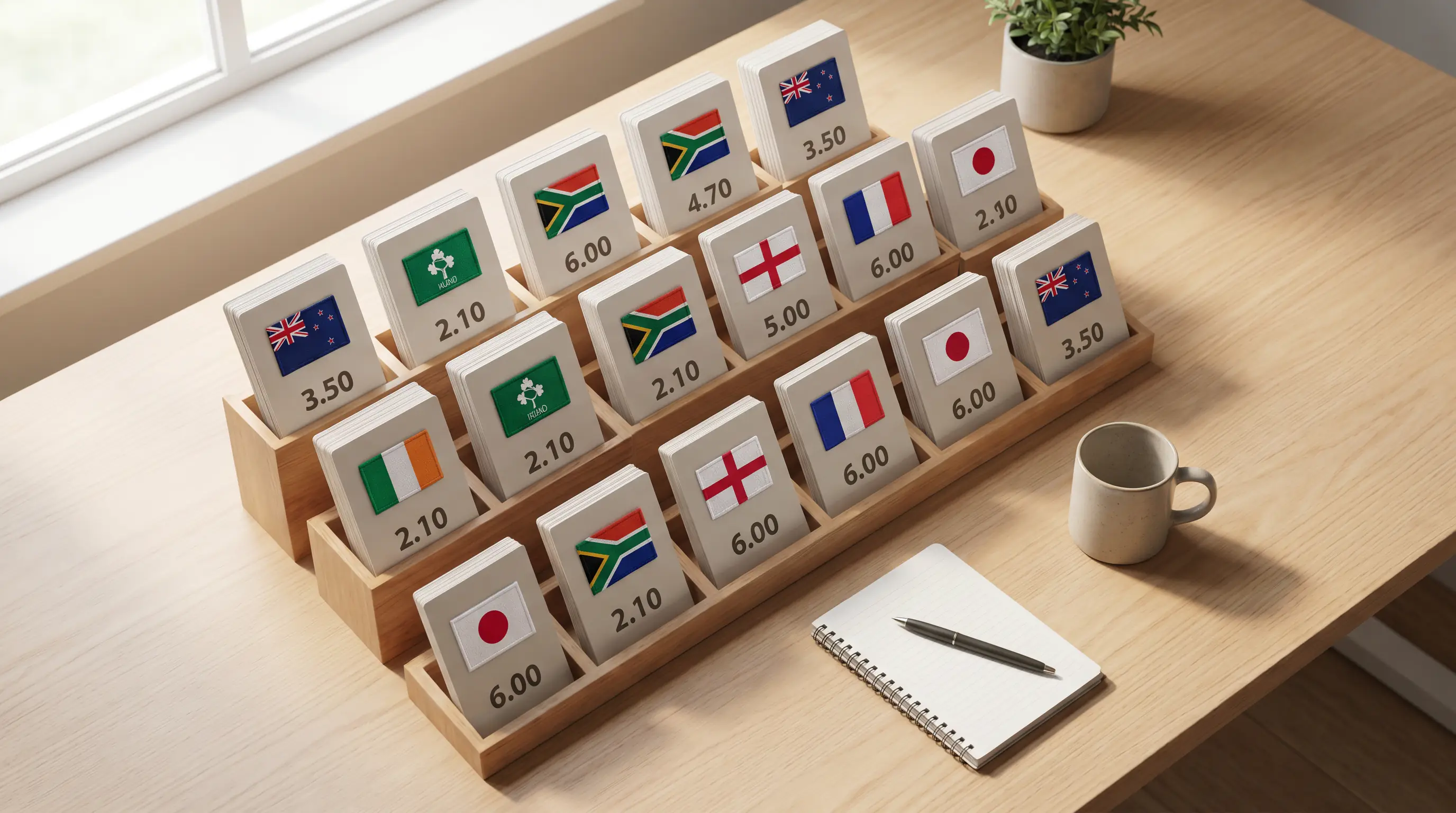
The top tier of the outright market comprises South Africa and New Zealand, typically priced at joint-favourites or within a point of each other. South Africa carry the defending-champion narrative; New Zealand carry the one-point-final-loss motivation and the Southern Hemisphere venue advantage. Behind them, France, Ireland, and England form a second tier at slightly longer odds, followed by Australia with a host-nation discount. From seventh to twelfth in the market, you find teams like Fiji, Argentina, Scotland, and Japan at prices ranging from 33/1 to 100/1.
The long tail — newly qualified nations and lower-ranked sides priced at 250/1 to 500/1 — exists primarily to satisfy the recreational market. These are not analytical bets; they are fantasy tickets. The serious outright analysis sits in the 3/1 to 50/1 range, where the implied probabilities are high enough to test against genuine data and where the each-way market adds a secondary layer of value.
What Drives Odds Movement Before Kick-Off
Outright odds are not static. They shift in response to four primary drivers, and tracking these movements gives you an information edge over punters who only look at the price on the day they decide to bet.
Six Nations and Rugby Championship results are the biggest movers. A team that wins a Grand Slam or dominates the TRC in the year before the World Cup sees their outright odds contract by 10-20% in implied probability terms. A team that loses three matches in a row sees their odds drift. These adjustments are mechanical — the market reprices based on the most recent data — but they sometimes overcorrect, creating windows where a team’s longer-term capability is underpriced because of a poor recent run.
Injury news to key players shifts odds rapidly, particularly for teams with limited depth at certain positions. A fly-half injury to a team’s first-choice kicker can move their outright odds by several points, because the kicking game is so central to World Cup success. Squad announcements, warm-up match results, and even coaching changes all contribute to the pre-tournament price discovery process.
The optimal window for ante-post outright betting, in my experience, is immediately after a result that causes the market to overcorrect. If Ireland lose a Six Nations match and their outright odds drift from 6/1 to 9/1, that might be the value window — provided your analysis of their long-term tournament capability has not changed. The market’s short-term memory is your strategic advantage.
 For a deeper look at how to read these odds technically, the main odds guide covers the mechanics of formats and implied probability.
A Framework for Assessing Outright Value
I evaluate outright odds using a simple model: assign each team an estimated probability of winning the tournament based on World Rugby ranking, World Cup pedigree, squad depth, and coaching experience. Then compare my probability to the implied probability in the market price. If my number is higher than the market’s, the bet has positive expected value.
This model is deliberately simple. Complicated models with dozens of variables tend to overfit to historical data and perform poorly on out-of-sample tournaments. The four inputs I use are each observable, updatable, and meaningful: ranking captures current form, pedigree captures tournament-specific performance, depth captures the ability to sustain performance over seven matches, and coaching captures the tactical edge that separates teams of similar playing quality.

The discipline required for outright betting is patience. The temptation to take a position on every contender is strong, but spreading your capital across five or six outright bets dilutes each position to the point where even a winning selection generates a modest return relative to the total outlay. I limit myself to two outright positions plus one each-way play, concentrating capital where my analysis identifies the strongest divergence between my probability and the market price.

For RWC 2027, I am watching two specific areas for outright mispricing. First, the host-nation premium on Australia: if the market overcorrects for home advantage, the Wallabies’ price may be shorter than their true probability justifies, which means opposing them by backing their opponents in specific matchups could be more profitable than an outright position. Second, the second-tier contenders (France, Ireland, England): these teams trade in a price band where the implied probabilities are close together, and a sharp movement in one team’s odds creates relative value in the others.

When do outright Rugby World Cup winner odds first become available?
Most major UK-licensed bookmakers open outright winner markets 18-24 months before the tournament kicks off, with initial prices available after the previous World Cup concludes. The market deepens and becomes more liquid as the tournament approaches, with significant repricing events around the pool draw, the Six Nations and Rugby Championship results in the tournament year, and squad announcements. The earliest prices are the longest and offer the most potential value, but they also carry the most uncertainty.
Can I place an each-way bet on the RWC outright winner market?
Yes. Most UK-licensed bookmakers offer each-way terms on the Rugby World Cup outright winner market. Typical terms are one-quarter the odds for a top-three or top-four finish, where ‘place’ is defined as reaching the semi-finals or the final depending on the operator. Each-way is particularly useful for teams in the 10/1 to 50/1 range, where the place portion provides a meaningful return if the team reaches the last four without winning the tournament.
