
 Available in US
Content

A friend called me last autumn — someone who watches every England match, has opinions on every selection, and has never placed a bet in his life. “I want to have a punt on the World Cup next year,” he said. “How do I actually do it?” He is not unusual. About 10% of UK adults bet on sport online, but for a huge number of rugby fans, the World Cup is the trigger that turns a spectator into a bettor for the first time.
This guide is for those people. If you already know how to bet on rugby world cup matches and are looking for strategy, this is not the page for you — I have covered that elsewhere. This is the practical, from-zero walkthrough: the legal background, what to look for in a betting operator, how to set up an account, how to navigate from the lobby to the bet slip, and how your payout is calculated when you win. Every step is UK-specific because the regulatory framework here is different from anywhere else in the world, and getting it right from the start saves you confusion later.
The Legal Landscape — Why UK Punters Start on Solid Ground
I spend a lot of time looking at betting markets in other jurisdictions — Australia, parts of Europe, the expanding US landscape — and the one thing I always come back to is this: UK bettors operate in the most regulated, most transparent gambling environment in the world. That is not marketing; it is a structural fact. And understanding the framework is the first step to betting with confidence rather than anxiety.
The Gambling Act 2005 is the bedrock. It established the UK Gambling Commission as the regulatory body responsible for licensing, compliance and enforcement. Every operator that accepts bets from UK residents must hold a UKGC licence. Operating without one is a criminal offence. That licence binds the operator to a set of conditions covering everything from fair terms and segregated customer funds to anti-money-laundering checks and responsible gambling obligations. If an operator breaches those conditions, the UKGC can fine them, suspend their licence, or revoke it entirely.
The regulatory landscape has tightened considerably since 2005. The Gambling Act Review White Paper, published in April 2023, introduced 62 specific reforms designed to modernise the framework. Among the most significant: mandatory stake limits on online slots, enhanced affordability checks for higher-spending customers, and stricter rules on bonus advertising. Andrew Rhodes, CEO of the UK Gambling Commission, framed the ambition clearly — the changes are designed to ensure Britain remains the safest and fairest place to gamble in the world.
For a new bettor, what does this mean in practice? It means the operator you sign up with has been vetted and licensed by a government regulator. It means your funds are protected. It means the odds you see are the odds you get — operators cannot change the terms of a settled bet. It means you have recourse through the UKGC or an alternative dispute resolution service if something goes wrong. And it means the operator is legally required to offer you self-exclusion tools, deposit limits, and reality checks if you want them.

The minimum age to bet in the UK is 18. This is enforced through mandatory identity verification during the account-opening process — you will not be able to deposit or place a bet until your age and identity have been confirmed. The verification requirements have become stricter in recent years, partly in response to the White Paper reforms and partly as operators invest in technology to speed up the process. Most platforms now verify within minutes using automated document checks.
One common question from newcomers: is it legal to bet on the Rugby World Cup specifically? Yes. There are no sport-specific restrictions on betting in the UK. You can wager on any licensed market offered by a UKGC-regulated operator, including all RWC 2027 fixtures. The only restrictions relate to age, identity verification, and certain product types — for example, credit card gambling was banned in April 2020.
Choosing an Operator — What Actually Matters
When I started betting on rugby, I picked my bookmaker because they sponsored the team I supported. That is about as rational as choosing a bank because you like their logo. The UK market has consolidated significantly — there are currently 5,825 licensed betting premises, down 1.8% year on year, and the clear trend is toward online platforms, which now account for 78.47% of all UK sports betting revenue. The operator you choose will be an online platform, and the criteria that matter have nothing to do with sponsorship deals.
A UKGC licence is non-negotiable. Every legitimate operator displays their licence number in the footer of their website and app. If you cannot find it, leave. The licence ensures regulatory oversight, fund protection, and dispute resolution access. I check it first, every time, even for well-known brands — because licences can be suspended or restricted, and the status can change.
Rugby market depth is the second criterion and the one most beginners overlook. Some operators offer excellent football coverage but treat rugby as an afterthought — a match result market, maybe a handicap, and nothing else. For RWC 2027, you want an operator that provides the full range: match result, handicap (including alternative lines), over/under totals, try scorer (first, anytime, last), outright futures, player props, and in-play markets. The best way to assess this is to check the operator’s current rugby offering during the Six Nations or The Rugby Championship — if the market range is thin during those tournaments, it will not magically expand for the World Cup.
Odds competitiveness is the third factor. As I covered in earlier analysis, the difference between the best and worst available price on a given market can materially affect your returns over a full tournament. I do not expect a beginner to maintain accounts with five bookmakers on day one, but having at least two allows you to compare prices on major markets and take the better one. Over 52 RWC matches, that habit pays for itself.
Mobile experience matters because most betting activity now happens on phones. Test the app before you commit: is the navigation intuitive? Can you find rugby markets within two or three taps? Does the bet slip function smoothly? Is the cashout feature responsive? A clunky app will cost you time during in-play betting, where seconds matter.
Finally, look at the responsible gambling tools on offer. Deposit limits, session time reminders, loss limits, and self-exclusion options should be accessible and easy to configure. For a detailed guide to UK Gambling Commission rugby betting rules and your rights as a punter, that linked piece covers the regulatory specifics in full.
Do not choose an operator based on a welcome offer or promotional deal. Those offers come with wagering requirements and restrictions that frequently make them less valuable than they appear. Choose based on market depth, odds quality, and user experience — the factors that affect every bet you place, not just the first one.
Opening an Account and Getting Verified
I remember the first time I opened a betting account online — it took about 20 minutes and I was nervous the entire time, as though I were applying for a mortgage. These days the process is faster and less intimidating, but there are a few steps you need to understand before you start, because skipping one or getting it wrong will delay your ability to place a bet.
Registration is the first step. You will provide your full name, date of birth, address, email and a mobile phone number. Use your real details — they will be verified against external databases, and any mismatch will flag your account for manual review. Choose a username and password, and set up two-factor authentication if the operator offers it. Most now do, and it is worth activating for the security of your funds.
KYC — Know Your Customer — verification is the mandatory identity check that every UKGC-licensed operator must perform before allowing you to deposit or bet. The standard requirement is proof of identity (passport, driving licence, or national identity card) and proof of address (a utility bill, bank statement, or council tax letter dated within the last three months). Most operators accept photographs or scans of these documents uploaded through the app or website. Automated verification systems can approve your account in minutes if your documents are clear and match the details you provided during registration.
If automated verification fails — which can happen if the photo is blurry, the document is expired, or the address does not match — the operator will ask you to resubmit or provide additional documentation. This is not a rejection; it is a regulatory requirement. Be patient, provide what is asked, and your account will be approved. In my experience, fewer than one in ten accounts require manual review, and the turnaround is usually within 24 hours.
Once verified, you can deposit funds. The available methods for UK bettors are debit card (Visa or Mastercard), PayPal, Apple Pay, Google Pay, Skrill, Neteller, and bank transfer. Credit cards are banned for gambling in the UK — this has been the law since April 2020. I recommend starting with a debit card or PayPal for simplicity. Set a deposit limit at this stage — most operators prompt you to do so during setup, and I strongly suggest you accept the prompt rather than skip it. A pre-set limit is the most effective tool for controlling your spending.

The whole process — registration, KYC, first deposit — can be completed in under ten minutes if your documents are ready. Have your passport or licence and a recent utility bill to hand before you start, and the process will be seamless.

From the Lobby to the Bet Slip — Placing Your First RWC Wager
Your account is open, verified and funded. Now what? The first time you log in to a betting platform, the sheer number of sports, markets and numbers on screen can be overwhelming. Here is the path through it, step by step, using a hypothetical RWC 2027 pool-stage match as the example.
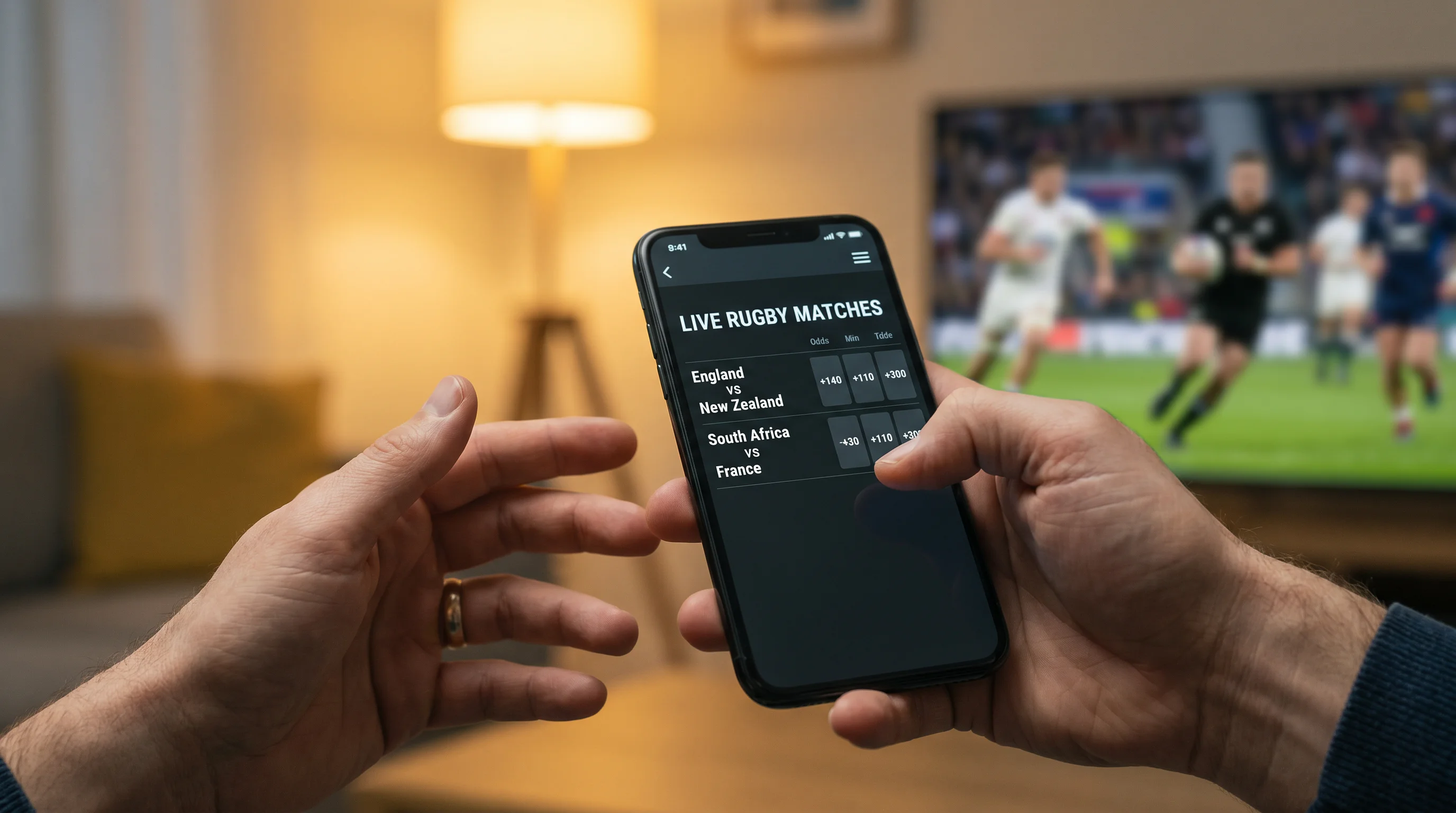
Step one: find rugby. From the homepage or lobby, look for a sports menu — usually a sidebar on desktop or a navigation bar on mobile. Select “Rugby Union” or “Rugby” (some operators separate union and league; you want union). Within the rugby section, you will see a list of competitions. During the RWC, “Rugby World Cup 2027” will be prominently displayed. Tap or click into it.
Step two: choose a match. You will see a list of upcoming fixtures with dates and kick-off times. Select the match you want to bet on — let’s say it is a pool-stage game between France and a qualifier. Tapping the match opens the available markets.
Step three: browse markets. The default view usually shows the match result market (France to win, draw, qualifier to win) with the odds displayed next to each selection. Scroll down or use tabs to access other markets: handicap, over/under, try scorers, and specials. Each market lists the available selections with their current odds.
Step four: make your selection. Tap the odds next to the outcome you want to back — for example, France to win at 1.08. The selection appears in your bet slip, which is usually a panel at the bottom of the screen on mobile or a sidebar on desktop. You can add multiple selections from different matches to build an accumulator, or keep it as a single bet.
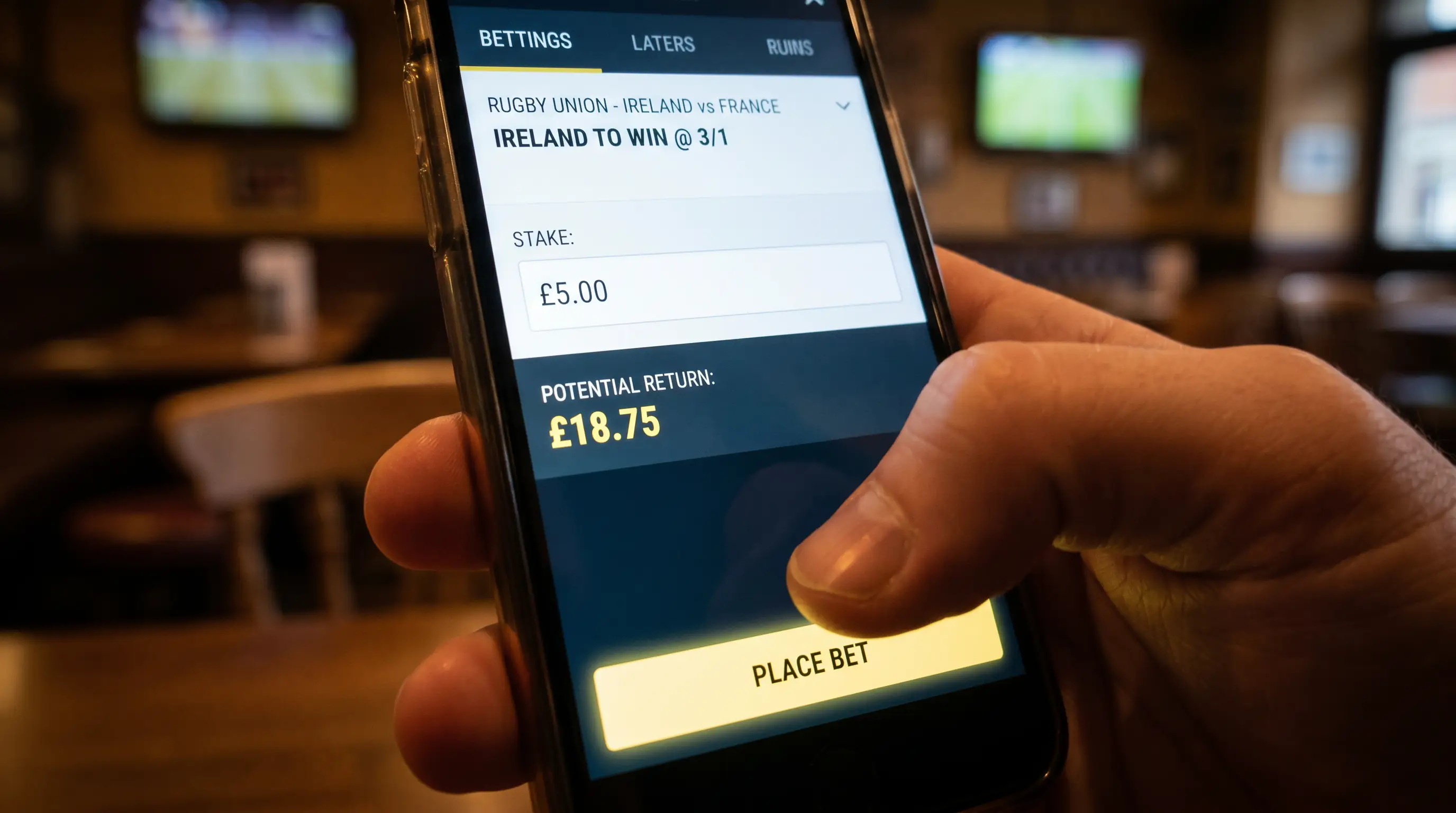
Step five: enter your stake. Type the amount you want to wager into the stake field on the bet slip. The potential return — calculated as stake multiplied by the decimal odds — appears automatically. For a five-pound single on France at 1.08, the potential return is five pounds and forty pence, including your original stake. Check the numbers, confirm you are comfortable with the stake, and tap “Place Bet” or the equivalent button.
That is it. The bet is live. You will receive a confirmation, and the bet will appear in your “My Bets” or “Open Bets” section where you can track it and, if available, use the cashout feature before the match ends.
A few practical points for your first time. Singles are simpler and lower-risk than accumulators — start with singles until you are comfortable with the process. Avoid placing your first bet on an in-play market, where the odds change in real time and the pace can be disorienting. And place a small stake — one or two pounds — on your very first bet, just to experience the process without the stress of meaningful money. You will learn more from a two-pound bet than from reading any guide, this one included.
Cashout deserves a mention because it confuses newcomers. Once a bet is placed, many operators offer you the option to “cash out” before the event is decided — locking in a profit if your position is winning or cutting your loss if it is not. The cashout value is calculated by the bookmaker and is almost always less favourable than letting the bet run, but it provides flexibility. I use cashout sparingly, primarily on accumulator bets where one leg has already lost or is at serious risk.
How Your Payout Is Calculated — and Why Tax Is Not Your Problem
One of the most common questions I get from new bettors is “do I have to pay tax on my winnings?” The answer, in the UK, is no. Betting duty is paid by the operator, not the customer. When you win a bet, the full amount — stake multiplied by decimal odds — lands in your account without any deduction. This has been the case since October 2001, when the government shifted the tax burden from punters to bookmakers. It is one of the most punter-friendly features of the UK market, and it means your return calculations are straightforward.
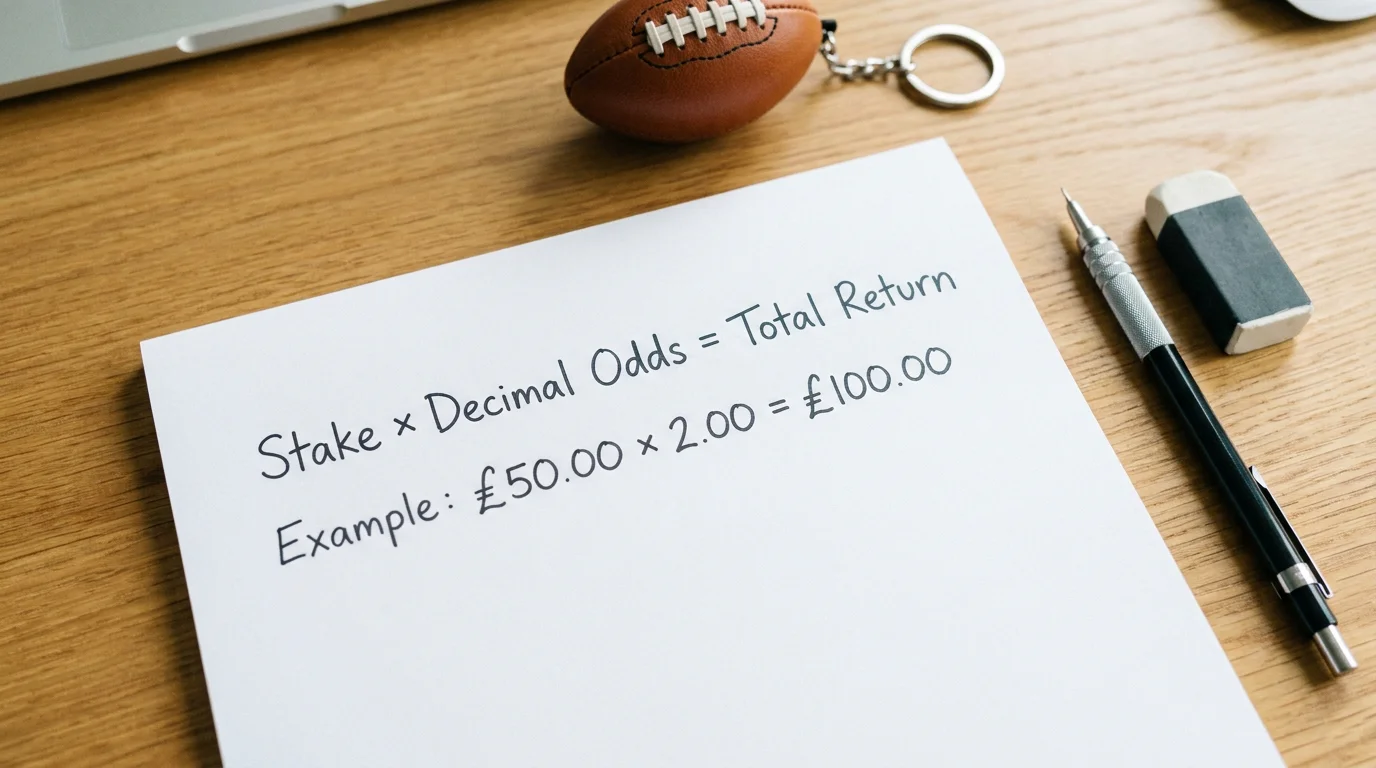
The basic formula is simple: total return equals stake multiplied by decimal odds. A ten-pound bet at decimal odds of 3.50 returns thirty-five pounds — twenty-five pounds of profit plus the original ten-pound stake. For fractional odds, multiply the stake by the fractional price and add the stake back: ten pounds at 5/2 returns ten times 2.5 equals twenty-five pounds profit, plus the ten-pound stake, for thirty-five pounds total. The numbers are identical because 5/2 fractional is 3.50 decimal.
Each-way bets split your stake into two parts: a win bet and a place bet. If you place a ten-pound each-way bet, your total stake is twenty pounds — ten on the win, ten on the place. The win part pays at full odds if your selection finishes first. The place part pays at a fraction of the odds — typically a quarter or a fifth for outright markets — if your selection finishes in the specified place range (usually top two, top three, or top four, depending on the market and the number of runners). If your team is priced at 10.00 each-way at quarter-odds for a top-four finish and they reach the semi-finals but lose, you collect on the place part: ten pounds at (10.00 minus 1) divided by 4, plus 1 = 3.25, returning thirty-two pounds fifty. The win part loses, costing ten pounds. Your net position: plus twelve pounds fifty.
Accumulator returns compound with each leg. If you combine three selections at 1.50, 2.00, and 1.80, the combined odds are 1.50 times 2.00 times 1.80 = 5.40. A ten-pound accumulator at those odds returns fifty-four pounds. The catch: all three selections must win. If any one loses, the entire bet loses. That compounding risk is why I recommend keeping accumulators short — three or four legs at most — and treating them as higher-risk, higher-reward plays rather than core strategy.
One final detail that trips up beginners: void selections. If a match is abandoned, a player is withdrawn before kick-off, or a market is voided for any other reason, your bet is usually settled as if that selection did not exist. In an accumulator, the void leg is removed and the remaining selections are recalculated at reduced odds. It is not a loss — it is a recalculation. Check the specific settlement rules on your operator’s help page, because the fine print varies.
Do I need to pay tax on Rugby World Cup betting winnings in the UK?
No. In the UK, betting duty is paid by the operator, not the customer. All winnings are received in full with no tax deduction. This has been the case since 2001, when the government shifted the tax burden from punters to licensed bookmakers. Your returns are calculated as stake multiplied by the decimal odds, and the full amount is credited to your account when a bet wins.
Can I use a credit card to bet on the Rugby World Cup?
No. Credit card gambling has been banned in the UK since April 2020. You can deposit funds using a debit card (Visa or Mastercard), PayPal, Apple Pay, Google Pay, bank transfer, or e-wallets such as Skrill and Neteller. The ban was introduced to prevent people from accumulating gambling debts on credit, and it applies to all UKGC-licensed operators without exception.
What is the minimum age to place a bet on the RWC in the UK?
You must be at least 18 years old to place a bet with any UK-licensed operator. Age verification is mandatory and is carried out during the account registration process through identity document checks. You will not be able to deposit funds or place a bet until your age has been confirmed. Attempting to register with false details is a criminal offence and will result in account closure and forfeiture of any funds.
