
 Available in US
Content

Every four years, the Rugby World Cup resets the betting landscape. Old assumptions about form, favourites and market structure are tested against a new set of conditions — different host country, different climate, different time zones, and now, for the first time, a different tournament format. Rugby world cup 2027 betting is shaped by all of these factors simultaneously, and understanding them before the bookmakers fully price them in is the entire game.
RWC 2027 runs from 1 October to 13 November 2027 in Australia. Twenty-four teams — up from twenty at every previous edition — will contest 52 matches across seven cities and eight stadiums over 19 match days. That expansion alone would make this tournament different. Add the introduction of a Round of 16 between the pool stage and the quarter-finals, a host nation with a point to prove after a decade of underperformance, and a viewing audience that reached 1.33 billion hours at RWC 2023 in France, and you have a tournament that will attract more betting volume than any RWC in history.
This article is your briefing document. I will walk you through the format, the venues, the impact of expansion on every major market, the key dates you need in your calendar, and an early assessment of the outright contenders. Think of it as the dossier you read before placing a single bet — the context that turns speculation into informed positioning. By the time you finish, you will understand precisely why this RWC is structurally different from every one that came before it, and how those differences create specific betting opportunities that did not exist four years ago.
Six Pools, a Round of 16, and What It Means for Your Bet Slip
I watched the RWC 2023 pool stage in France and noticed something that had bothered me for years: by the third round of group matches, several games were effectively dead rubbers. Teams already qualified were resting players; teams already eliminated were playing for pride. The betting markets on those fixtures were thin, the edges non-existent, and the spectacle diminished. World Rugby clearly noticed the same thing.
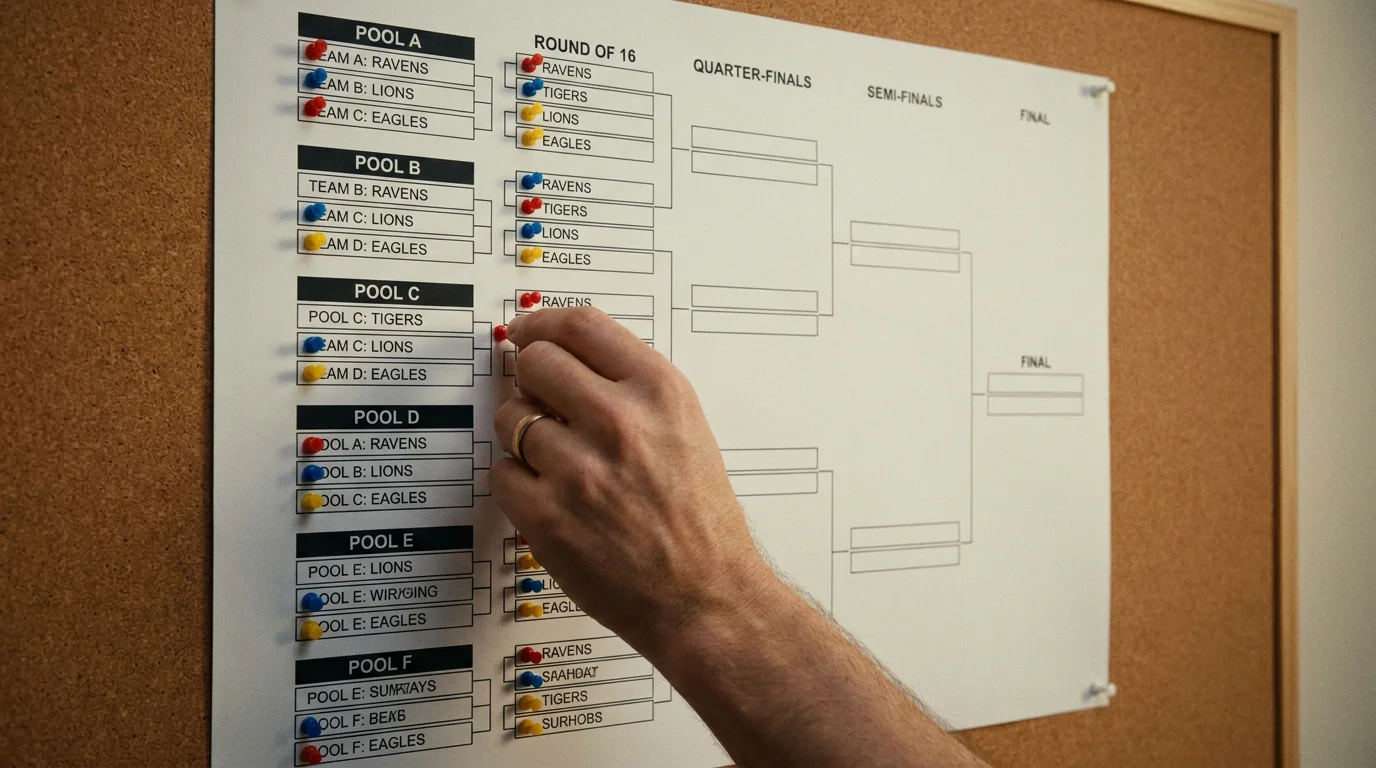
The new format for 2027 splits 24 teams into six pools of four. Each team plays three group matches — one fewer than the five-team pool format that has been used since 1999. The top two from each group, plus the four best third-placed teams, advance to a Round of 16. From there, it is a straight knockout bracket through quarter-finals, semi-finals and the final. Alan Gilpin, World Rugby’s CEO, described the rationale plainly: a more compact tournament with six pools of four moving into a round of 16, generating more knockout content — the kind of high-stakes matches that fans and broadcasters most want to see.
For bettors, the structural change is significant in three ways. First, the pool stage becomes more forgiving. With only four teams per group and 16 qualifying spots from 24 teams, two-thirds of all participants advance. A single pool-stage defeat does not necessarily spell elimination, which changes the calculus on group-winner markets. The price on any given team to top their pool should be shorter than the equivalent price under the old format, because fewer teams are competing for the position and even a loss can still lead to qualification.
Second, the Round of 16 creates an entirely new layer of knockout betting. In previous tournaments, the jump from pool stage to quarter-final was abrupt. Now there is an intermediate round with its own match result, handicap, over/under and try scorer markets. That is eight additional knockout fixtures, each one priced individually. For analytical bettors, more matches means more opportunities to find mispriced lines — particularly in the early hours of the Round of 16, when the market is still adjusting to final group standings.
Third, the “pool of death” dynamic changes. Under the old format, two heavyweights in a five-team pool created a near-certain knockout-stage collision. Under the new format, both can qualify even if they are in the same group — they just need to finish in the top two or be among the best third-placed teams. The market impact: outright prices for teams in tough groups should contract less than under the old system, because the format provides more escape routes.
The initial ticket sales reflect the excitement around the new structure. Over 750,000 tickets were sold in the opening sales phase, out of a total allocation of 2.5 million — a strong early indicator that stadium attendance will match or exceed the 2.4 million spectators who attended RWC 2023 in France.
I am already building my models around the 16-team knockout bracket rather than the old 8-team quarter-final format. The adjustment is not trivial — it changes seeding dynamics, rest-day calculations, and the probability pathways for every team in the draw.
Seven Cities, Eight Stadiums — the Venue Map for Bettors
Australia stretches roughly 4,000 kilometres from coast to coast, and the RWC 2027 venues are spread across the eastern seaboard plus Perth in the west. That geographical spread creates logistical and climatic variables that do not exist in a compact European host country. When France hosted in 2023, the maximum travel distance between venues was a few hundred kilometres. In Australia, teams flying from Perth to Brisbane cover nearly 3,600 kilometres — a four-hour flight. Fatigue from travel is not a marginal factor; it is a scheduling input that should appear in your model.
The eight stadiums range from purpose-built rugby arenas to multipurpose ovals adapted for the tournament. Sydney’s Stadium Australia is expected to host the final, with a capacity exceeding 80,000. Melbourne’s MCG could feature in the semi-finals. Brisbane’s Suncorp Stadium — widely regarded as one of the best rugby grounds in the world — will likely be a key pool-stage venue. Smaller grounds in Newcastle, Townsville and Perth offer tighter, more atmospheric settings where the crowd noise can influence referee decisions and player concentration.
For bettors, venue matters because of conditions. October in Melbourne can be cool and wet — average temperatures around 15 degrees Celsius with regular rainfall. October in Brisbane sits closer to 25 degrees with higher humidity. Townsville, in tropical north Queensland, averages 28 degrees in October with a dry-season tail-end that produces firm, fast pitches. These variations affect playing style and, by extension, the over/under line. Expect lower-scoring matches in Melbourne rain and higher-scoring affairs on the hard tracks of Townsville and Brisbane.

Time zones add a layer for UK-based bettors. Eastern Australia is 10 to 11 hours ahead of GMT depending on daylight saving. A match kicking off at 18:00 in Sydney starts at 07:00 or 08:00 in London. Weekend fixtures may align with UK morning routines, but midweek games — especially those starting at Australian lunchtime — will fall in the early hours UK time. This matters for in-play betting: if you plan to bet live, you need to decide in advance which matches justify the alarm clock. Pool-stage matches between two tier-one sides, particularly those with tight handicap lines, are worth the effort. Mismatches rarely are.
Pitch dimensions vary between Australian venues, and the switch from oval-shaped grounds to rectangular ones affects try-scoring patterns. Wider pitches favour teams with pace on the wing; narrower grounds favour forward-dominant sides. I track try-scoring distribution by channel — left wing, right wing, centre — and compare it against each venue’s dimensions to adjust try scorer market probabilities.
From 20 to 24 Teams — How Expansion Reshapes Every Market
When the Rugby World Cup expanded from 16 to 20 teams in 1999, the betting market barely noticed. The four additional sides were overwhelmingly outclassed, their matches were one-sided affairs, and the serious business — outright and knockout markets — was unaffected. The expansion to 24 teams for 2027 is different. It is different because the gap between the established nations and the emerging ones has narrowed, because the new format creates genuine knockout stakes for every team, and because the economics of the tournament now demand competitive depth.
RWC 2023 demonstrated the commercial power of the World Cup at full throttle. The tournament generated 1.33 billion viewing hours — a record that was 19% above RWC 2019 in Japan and 30% above RWC 2015 in England. The economic impact was equally striking: cumulative expenditure reached 1.8 billion euros, with a net contribution of 871 million euros to the French economy. Those figures underpin the argument for a larger tournament — more teams, more matches, more broadcast hours, more revenue. The betting market is a direct beneficiary: more fixtures create more markets, and more markets create more opportunities for analytical bettors.
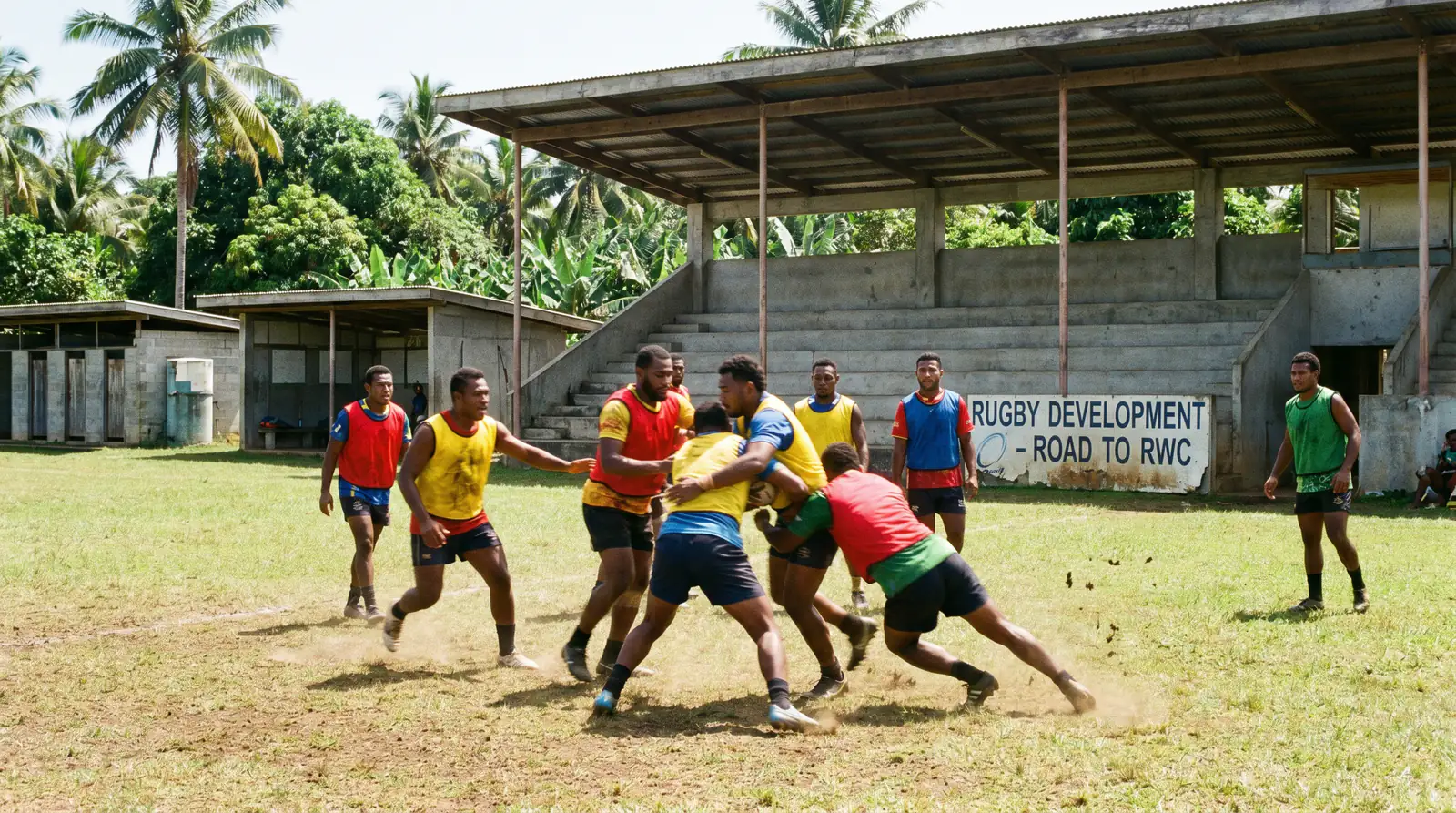
The four additional teams in 2027 will come from the qualification pathway, which includes regional tournaments in Africa, the Americas, Asia-Pacific and Europe. Teams such as Spain, Portugal, Hong Kong and Kenya are all realistic contenders for the extra places. Their inclusion creates a specific betting dynamic: pool-stage mismatches where the handicap line sits at 30 or 40 points. These matches are attractive for handicap bettors who can model scoring patterns against weaker opposition, and for the over/under market where totals can run high.
But the real market impact of expansion is in the knockout rounds. Under the 20-team format, eight teams qualified for the quarter-finals. Under the 24-team format, 16 teams qualify for the Round of 16. That means teams ranked 9th through 16th — roughly, the better third-placed sides and some second-placed teams from weaker groups — now have a knockout match to play. These are the teams the market is least certain about. Their implied probabilities in pre-tournament outright markets will be wide, their match-by-match pricing will be volatile, and their knockout fixtures will attract less betting volume. Lower volume means less efficient pricing. Less efficient pricing means larger potential edges.
I am paying particular attention to the “bubble” teams — those ranked roughly 8th to 14th in the world, who under the old format might have scraped a quarter-final spot or missed out entirely. In the new format, they are almost certain to reach the last 16, which gives their outright odds a floor that did not previously exist. A team priced at 34.00 to win the tournament but with a 50% chance of reaching the quarter-finals via the Round of 16 may offer value on an each-way basis that the headline price obscures.
Expansion also dilutes the average quality of pool-stage opposition, which means the leading nations should cruise through groups with wider margins. That has implications for the handicap market: lines on tier-one versus newcomer matches will be among the largest at any RWC, and historical data from equivalent mismatches will be the primary pricing input. The question for bettors is whether the newcomers can compete closely enough to beat those inflated spreads — and the early evidence from qualification cycles suggests that at least a few will surprise.
The Bettor’s Calendar — Key Dates from Pool Draw to the Final
I treat the RWC betting cycle as a 12-month project, not a six-week sprint. The critical dates stretch from the pool draw — typically held about a year before the tournament — through squad announcements, warm-up fixtures, and the tournament itself. Each milestone triggers a wave of odds movement, and being positioned before each wave is where the edge lies.
The pool draw is the first major inflection point. Once the groups are set, the outright market restructures around the draw’s implications. Teams in soft groups see their odds shorten; teams drawn against strong opponents see their prices lengthen. The draw also opens group-winner markets and qualification-stage prop bets (e.g., “will team X finish in the top two of their pool?”). I place my initial outright positions within 24 hours of the draw, before the market fully digests the implications.
Squad announcements, typically finalised six to eight weeks before kick-off, are the second trigger. A 33-man squad that includes all frontline players confirms the team’s intentions. A squad missing key names — through injury, retirement, or selection surprise — sends outright and match markets into immediate repricing. I monitor squad lists from every tier-one nation and compare them against my pre-draw model. If the squad is stronger than expected, the model updates; if weaker, I reassess my positions.
Warm-up fixtures in August and September provide the last data before the tournament. These matches are tricky — coaches often rest first-choice players, experiment with combinations, and manage minutes. I treat warm-up results with caution but pay close attention to injury reports that emerge from them. A full-strength XV losing by ten points in a warm-up is not alarming. A key fly-half limping off at half-time is.
The tournament itself breaks into three phases. Pool stage: 1 October to approximately 18 October. Round of 16: late October. Quarter-finals through to the final: late October to 13 November. The pool stage is where I gather live data, refine models, and identify overreactions. The knockout stage is where I deploy the bulk of my bankroll — because by that point, I have match-specific data from the tournament itself, not just extrapolations from the Six Nations.
Mark these dates, set calendar reminders, and treat each one as a decision point. The bettor who is prepared for each milestone will consistently outperform the one who wakes up on opening day and scrambles.

Early Outright Odds — Where the Six Contenders Stand
Outright markets for RWC 2027 are already live on most major platforms, and even at this stage — more than a year out — the shape of the market tells you a great deal about how bookmakers view the tournament. Six teams dominate the front of the market, and each one carries a distinct profile of strengths, vulnerabilities, and pricing dynamics.
South Africa enter as defending champions and occupants of the world number one ranking for most of the past cycle. Their forward pack is the deepest in international rugby, their coaching setup under Rassie Erasmus has delivered two consecutive Webb Ellis Cups, and their record in knockout rugby is impeccable. The market prices them accordingly — typically shortest or second-shortest in most books. The question for bettors is whether the ageing of key players across the front five and back row will erode the advantage before October 2027. My early read is that the price reflects their pedigree accurately, which means limited outright value.

New Zealand are the perennial contenders. Despite a disappointing 2023 campaign where they lost the final to South Africa by a single point, the All Blacks retain the talent pipeline and coaching intensity that makes them dangerous at every tournament. Early prices usually offer marginally longer odds than South Africa, and the value question hinges on whether the current coaching transition stabilises before the tournament.
France carry the expectation of a golden generation — a squad that reached the RWC 2023 quarter-finals on home soil and features elite talent across every position. Playing in Australia removes the home advantage that was supposed to carry them in 2023, and their away record in the Southern Hemisphere is the weak point in an otherwise compelling profile. If the early price drifts after a poor Six Nations or a patchy summer tour, France could offer the best value among the top tier.
Ireland have been the most consistent team in the world over the past four years, including a Six Nations Grand Slam and multiple series wins in the Southern Hemisphere. Their RWC record is the asterisk: a quarter-final exit in 2023 continued a pattern of underperformance at the tournament stage. The market applies an “Ireland discount” at every World Cup, and the question is whether that discount is too large. If you believe this squad is genuinely different, the early outright price may be generous.
England are in a rebuilding phase under Steve Borthwick but possess the forward talent and set-piece quality to grind through a tournament. Their price tends to be longer than their true knockout capability warrants, particularly if the draw is favourable. Australia, as hosts, will attract patriotic money that shortens their odds beyond what form and ranking support. I treat host-nation pricing with scepticism until I see evidence that the home advantage is translating into results during the build-up season.
This early assessment is a snapshot, not a recommendation. The value of reading it now is establishing a baseline against which to measure every subsequent market movement.
How many matches will there be at Rugby World Cup 2027?
RWC 2027 features 52 matches in total: 36 pool-stage games across six groups of four teams, eight Round of 16 fixtures, four quarter-finals, two semi-finals, a bronze final and the championship final. That is four more matches than RWC 2023, which had 48 games under the old 20-team, four-pool format. The additional fixtures come from the new Round of 16 knockout round.
When do bookmakers release the full range of RWC 2027 markets?
Outright winner markets are already available on most UK-licensed platforms. Match-level markets — handicap, over/under, try scorer — typically open four to six weeks before the tournament for pool-stage fixtures, and are released for knockout games once the bracket is confirmed. The pool draw is the key trigger: once groups are finalised, bookmakers open group-winner, qualification and match-specific markets. Warm-up fixtures in August and September usually prompt the release of early-round match odds.
Does the new Round of 16 create additional betting opportunities?
Yes. The Round of 16 adds eight knockout matches that did not exist under the previous format. Each fixture generates its own set of markets: match result, handicap, over/under, try scorer, and specials. Because these are the first knockout-stage games, market efficiency tends to be lower — bookmakers have less tournament-specific data to work with, and some matchups will feature teams the market has not priced in a knockout context before. For analytical bettors, the Round of 16 represents the single biggest new opportunity created by the format change.
