
 Available in US
Content

The last time Australia hosted a Rugby World Cup, they lost the final. At home. To England. In extra time. That was 2003, and every Wallabies supporter I have spoken to since mentions it within three sentences of the topic. Australia rugby world cup host advantage is a real factor — the data confirms it across ten editions of the tournament — but 2003 proved that home soil guarantees nothing when the opposition has a Jonny Wilkinson and a drop-goal opportunity.
RWC 2027 returns to Australia for the first time in 24 years. The Wallabies enter as a team in the middle of a rebuilding cycle, ranked lower than several other contenders, but with the intangible of home support, familiar conditions, and zero travel fatigue. For bettors, the question is quantifiable: how many points is host advantage worth in a World Cup context, and is the market pricing it correctly?
The Historical Record of Host Nations
Nine nations have hosted the Rugby World Cup across ten tournaments (New Zealand hosted twice). RWC 2023 in France generated a staggering €1.8 billion in total expenditure and a net economic contribution of €871 million — numbers that illustrate the scale of a modern World Cup and the pressure on host nations to perform on and off the pitch.

Here is the host nation record. New Zealand won at home in 1987 and 2011. South Africa won at home in 1995. Those are the three success stories. On the other side: England reached the final in 1991, Australia reached the final in 2003, and then the wheels came off. England were eliminated in the pool stage at their own 2015 World Cup — the worst home performance in tournament history. Japan reached the quarter-finals at home in 2019, a remarkable achievement for a Tier 2 side but short of the semi-finals. France, with arguably the strongest squad in the world, exited in the quarter-finals at home in 2023.
The pattern suggests that host advantage is real but not decisive. Three wins out of ten attempts is a 30% conversion rate — better than the base rate for any single team winning the tournament, but hardly overwhelming. More importantly, the trend is negative: no host has won since 2011, and the three most recent hosts all fell short in the knockout rounds.

What Makes Australia’s 2027 Hosting Unique
Over 750,000 tickets were sold in the initial sales phase for RWC 2027, out of a total allocation of 2.5 million. That demand reflects both Australia’s appetite for live rugby and the broader appeal of the expanded 24-team tournament. For the Wallabies, those numbers translate into packed stadiums across Sydney, Melbourne, Brisbane, Perth, Adelaide, Newcastle, and Townsville — a support base that touring teams will not enjoy.

The conditions in Australia favour a specific style of rugby. October and November in the Australian spring produce dry, firm pitches with warm temperatures. Brisbane and Townsville are subtropical; Sydney and Melbourne are temperate but rarely wet during this period. These conditions suit fast, expansive rugby with ball-in-hand attacking play — which is what the Wallabies are building toward under their current coaching setup, and which historically favours Southern Hemisphere teams who train on similar surfaces year-round.
Time zones also matter. Australian kick-off times that suit prime-time local audiences will fall in the early morning in the UK and late night in the Americas. For the Wallabies, there is no jet lag, no body-clock adjustment, no travel fatigue between venues. For touring Northern Hemisphere sides, the 8-11 hour time difference requires a two-to-three-week acclimatisation period that cuts into preparation time. Teams arriving late or managing the adjustment poorly will underperform their ranking, particularly in the opening pool fixtures.

How Host Advantage Shows Up in the Odds
Historically, bookmakers price host advantage as an implicit adjustment of 1-2 World Rugby ranking positions. A team ranked 8th that hosts the World Cup is priced closer to how a 6th-ranked team would be priced at a neutral venue. For the Wallabies, who are likely to enter RWC 2027 ranked somewhere between 6th and 10th in the world, that adjustment shortens their outright odds meaningfully — from potential 20/1 to something closer to 12/1 or 14/1.
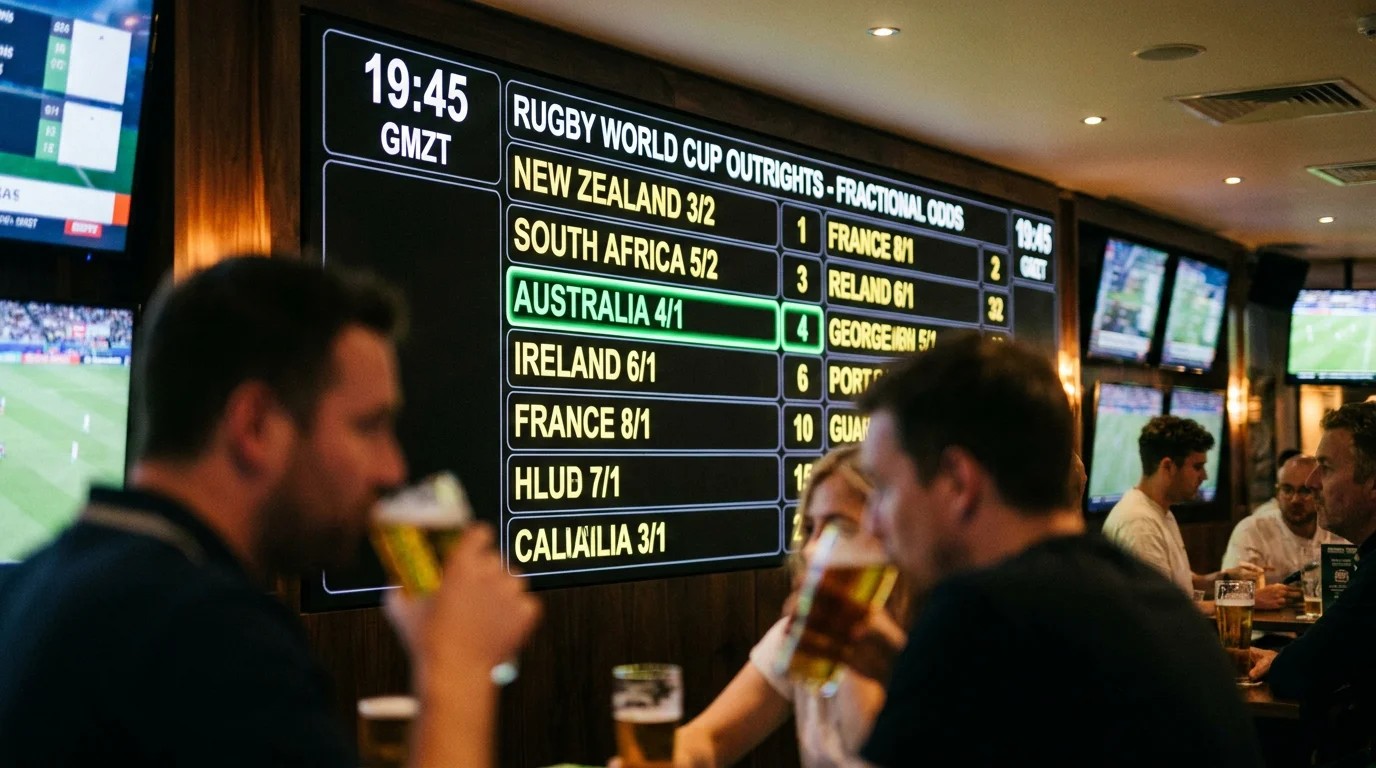
The risk for bettors is that this adjustment overstates the advantage. France in 2023 were the strongest example: the market priced them as genuine favourites on home soil, and they were eliminated in the quarter-finals by South Africa. The public money that flows onto the host nation — driven by patriotic sentiment and media hype rather than analytical assessment — inflates the implied probability beyond what the data supports.
My approach is to separate the structural advantage (conditions, support, zero travel) from the emotional adjustment (public money, media narrative). The structural advantage is worth backing in pool-stage handicap bets, where the Wallabies will have genuine edges in intensity and crowd support against lower-ranked opposition. The outright market, though, requires the Wallabies to be good enough to beat two or three Tier 1 teams in consecutive knockout matches — and that is a higher bar than home advantage alone can clear. For bettors looking at how this hosting dynamic fed into the overall 2027 tournament briefing, the venue and conditions analysis provides the full picture.

One angle I find particularly worth monitoring: the Wallabies’ handicap line in their opening pool match. Historical data shows host nations outperform their ranking-adjusted expectation most dramatically in the tournament opener, when the crowd energy is at its peak and the emotional lift is fresh. By the third pool match, that advantage normalises. If Australia open RWC 2027 against a lower-ranked opponent, the handicap cover in that specific fixture may be the highest-probability host-advantage play of the entire tournament.
How often has the host nation won the Rugby World Cup?
Three times out of ten tournaments. New Zealand won at home in 1987 and 2011, and South Africa won at home in 1995. No host nation has won since 2011, and the three most recent hosts — England (2015), Japan (2019), and France (2023) — all failed to reach the semi-finals. The conversion rate of 30% is better than the base probability for any single team, but the recent trend suggests that host advantage alone is not sufficient for tournament victory.
Does home advantage apply more to pool-stage or knockout matches at RWC?
The data suggests home advantage is stronger in the pool stage, where crowd support, familiar conditions, and the absence of travel fatigue create a tangible performance boost. In knockout matches, the level of opposition is higher and the margins are tighter, which means individual quality and tactical preparation matter more than environmental factors. The most recent host exits — France and Japan both in the quarter-finals — suggest that home advantage fades as the tournament progresses into the do-or-die rounds.
