
 Available in US
Content

The bet that taught me the most about rugby world cup prop bets was not on a try scorer or a match winner. It was a wager on total tackles made by a specific flanker during RWC 2015. I had spent the week before the match poring over his tackle counts from the Premiership season, noticed he averaged 14 per game, and the bookmaker had set the line at 10.5. He finished with 17. That kind of disconnect between seasonal data and tournament pricing is exactly where props become profitable.
Prop bets — short for proposition bets — cover everything beyond the match result. At a Rugby World Cup, the range expands dramatically because the tournament attracts casual punters who want novelty, and operators respond by opening markets they would never offer for a regular-season club match. With RWC 2027 bringing 24 teams and 52 matches to Australia, the prop bet menu will be the largest in World Cup history.
Player Props and the Data Behind Them
Player props ask you to predict an individual’s statistical performance: tackles made, carries, metres gained, penalties kicked, or tries scored. The beauty of these markets is that they reward deep knowledge of specific players rather than broad tournament awareness.
Roughly 290 million bets are placed online each month in the UK, and the share going to player props has been growing steadily as data availability improves. For rugby specifically, the key statistical categories for player props are tackles (back-row forwards and centres dominate), carries (number eights and inside centres), metres gained (wings and full-backs), and penalties kicked (fly-halves). Each of these has a seasonal average that can be compared against the tournament line.
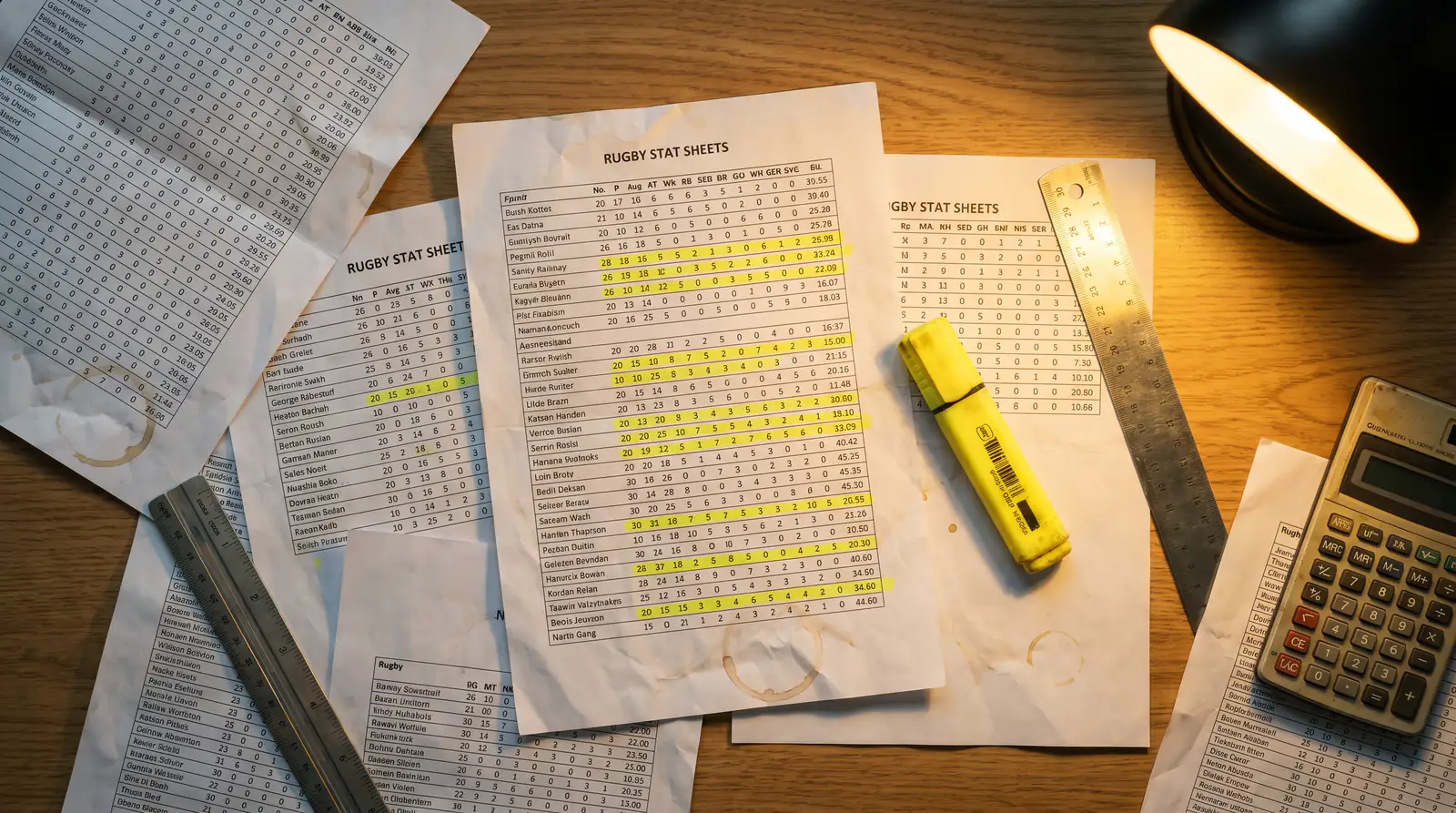
My approach to player props is straightforward: I compile the player’s last ten test matches, calculate the median for the relevant statistic, and compare it against the operator’s line. If the median sits comfortably above or below the line, I have a starting position. But I also adjust for opponent strength — a flanker facing a weaker forward pack in a pool-stage mismatch will likely make fewer tackles because his team will dominate possession, reducing defensive work. Conversely, in a tight knockout match, tackle counts spike as defensive intensity increases.
The trap with player props is small sample size. International rugby players may only play eight to twelve test matches per year. That is not enough data for statistical confidence, so I weight recent form heavily and cross-reference with club data from the Premiership, Top 14, or Super Rugby to fill the gaps. The first try scorer market is one prop category where positional data matters even more than individual stats.

Match Props Beyond the Scoreboard
Match-level props shift the focus from individual players to game events. The most popular at a World Cup are first scoring method (try, penalty goal, or drop goal), total yellow cards, whether a red card will be shown, and half-time/full-time result combinations.
First scoring method is a market I revisit at every tournament because the data is surprisingly consistent. Across the last three World Cups, approximately 55% of matches opened with a penalty goal rather than a try. In knockout matches, that figure climbs above 65% because both teams play conservatively in the opening minutes, trading territorial kicks until a penalty opportunity arises. Backing a penalty goal as the first scoring method at 6/5 or better is a repeatable strategy for knockout fixtures.

The global in-play betting market, valued at $22.9 billion and growing at 13% annually, has expanded the range of match props available during a game. Live props like next scoring method, next sin bin, and next team to score are now standard during World Cup matches. These live props are essentially match props with a clock attached, and the same analytical framework applies — you just need to process the in-game data faster than the odds engine adjusts.

Tournament Specials That Span Six Weeks
Beyond individual matches, RWC 2027 will offer tournament-wide prop markets that run across the entire six-week competition. The main ones are top tournament try scorer, highest-scoring match, team to score the most tries overall, and the Golden Boot for the top points scorer.
The top try scorer market is seductive but structurally difficult. It rewards volume as much as talent — a winger on a team that reaches the final plays more matches and therefore has more try-scoring opportunities than one whose team exits in the pool stage. The smart approach is to identify the most prolific finisher on a team likely to reach at least the semi-finals, rather than the player with the best per-match try rate on a team that might not escape the group.

Highest-scoring match is a prop I approach with historical anchoring. At RWC 2023, the highest-scoring fixture was typically a pool match between a Tier 1 and Tier 3 side — the kind of contest where one team racks up 60-plus points on a fast track. With four additional teams at RWC 2027, the ceiling for the highest-scoring match may climb even further, and early-tournament pool fixtures on dry Australian pitches are the likeliest candidates. I look for props set below 100 total match points and consider the over if the fixture list contains at least two genuinely lopsided pool games in the opening week.

The Golden Boot market — top overall points scorer — overlaps with player props but runs for the full tournament rather than a single match. It rewards a kicker from a deep-running team far more than a prolific try scorer from a team that exits early. Treat it as a separate analysis from match-day player props; the variables that drive it are team progression and kicking opportunity frequency, not individual match performance.
Are prop bet odds typically better or worse value than main market odds?
Prop bets generally carry a higher bookmaker margin than main markets like match result or handicap because they attract lower volume and more recreational money. However, this higher margin also means the lines are set with less precision, creating opportunities for bettors who have access to detailed player or event-level data. The value is not in the odds structure itself but in identifying specific props where your analysis gives you an edge the broader market lacks.
Which player statistics are most reliable for evaluating RWC prop bets?
Tackle counts and penalty goals kicked are the most reliable because they have the lowest variance across matches. A back-row forward’s tackle count stays within a relatively tight range game to game, and a first-choice goal kicker’s conversion and penalty rates are similarly stable. Carries and metres gained are more volatile because they depend on game state and possession share. Try scoring is the least predictable — even elite finishers go two or three matches without scoring.
